Pages

Showing posts with label veterinary education. Show all posts

Friday, April 15, 2016

AVMA / AAVMC Report Looks at Market for Veterinary Education

The American Veterinary Medical Association and the Association of American Veterinary Medical Colleges have released the 2016 Report on the Market for Veterinary Education, making it available for free download by all AVMA members as part of the AVMA’s 2016 economic reports series.

Some key findings from the report:
  • Starting salaries for new veterinary graduates and the number of new graduates obtaining full-time employment prior to graduation are increasing. These changes are due to an increase in disposable income that occurs in an economic expansion. 
  • However, the debt load of new veterinarians also has continued to increase, offsetting the income gains. As a result, the debt-to-income ratio for new veterinarians has held steady at nearly 2 to 1. A more sustainable debt-to-income ratio would be 1.4 to 1. 
  • For at least the last three decades, the public has been defunding public education, while the real costs of operating schools has risen. For the veterinary profession, this has shifted the burden of providing animal health from the taxpayer to the animal owner. 
  • 2015 applicants to U.S. veterinary schools had a relatively accurate idea of the debt load of new veterinarians.
Click here for more information.

Monday, April 11, 2016

New Iowa State University Research Seeks to Answer Lingering Questions on the Leading Cause of Lameness in Cattle

Paul Plummer
AMES, Iowa – Iowa State University veterinarians have uncovered new insight into the development of a foot disease in cows that causes more lameness than any other malady.

Bovine digital dermatitis, a disease that appears as painful lesions on the heel of a cow’s hoof, has caused difficulty for the U.S. dairy industry for decades and has become a growing concern for beef producers as well, said Paul Plummer, an assistant professor of veterinary diagnostic and production animal medicine.

Plummer leads a group of researchers at the ISU College of Veterinary Medicine studying the disease and potential treatments for its management. The researchers recently published an article in the peer-reviewed Journal of Dairy Science that takes a close look at the epidemiology of the disease, revealing new information on how the disease develops and how likely it is to recur after treatment.

“People have been researching this disease for 40 years,” Plummer said. “But we still don’t understand its exact causes.” Veterinarians often link bovine digital dermatitis to a form of pathogenic bacteria known as treponemes because the bacteria are usually present in the advanced lesions caused by the disease. But Plummer said the ISU research showed that treponemes don’t appear during the earlier development of the disease, suggesting that other bacteria may drive the disease process and later create a favorable environment for the treponemes to thrive.

“The treponemes might be the rowdy guys causing problems at the end of the party, but they’re not necessarily the ones who started the party,” Plummer said. Plummer and his team have studied 60 cows at the ISU Dairy Farm for three years. They took regular photos of the hooves of each animal to create a trail of data for each cow. When they found an animal with lesions caused by digital dermatitis, they went back through their photos and data to look for patterns in the early development of the disease.

The study also allowed them to catalog cases of recurrence after treatment and how often the disease resulted in lameness, or immobility. The research showed that a majority of cows that contracted the disease weren’t lame, a finding that has implications for how dairy and beef producers should track the disease.

“So if you’re only looking at specific occurrences of lameness in a herd, you may be missing a lot of cases,” he said. “Just looking at lameness doesn’t give a full picture of the disease.”

Last year, Plummer and his team received a three-year, $500,000 grant from the U.S. Department of Agriculture's National Institute of Food and Agriculture to assess best practices for treatment and management of digital dermatitis on farms and to study the disease on beef feedlots, where it’s becoming more common.

Bovine digital dermatitis has largely affected the dairy industry, and dairy producers have managed the disease through the use of walk-through footbaths installed between milking parlors and barns that cows travel through before and after they’re milked. But in recent years, the disease has increasingly shown up in beef feedlots, where footbaths are less practical.

Plummer said it’s unclear why beef cattle feedlots have recently developed more problems with digital dermatitis. Environmental contamination issues likely play a role, because feedlots tend to have persistent problems with the disease once infected, he said.

“Dairy farmers have learned to manage the disease and minimize lameness,” Plummer said. “But feedlots aren’t equipped in the same way to do that. Controlling the disease is a lot more difficult on the feedlots.”

Plummer’s collaborators at Iowa State include Adam Krull, Jan Shearer, Patrick J. Gorden and John Coatney, all from the ISU Department of Veterinary Diagnostic and Production Animal Medicine.

Monday, March 28, 2016

View a Slideshow of Nebraska Veterinary Diagnostic Center Construction Photos


The Nebraska Veterinary Diagnostic Center on the UNL campus in Lincoln is tentatively scheduled to be completed in February 2017. You can see a slideshow that tracks construction progress through photographs by clicking here.

Friday, March 4, 2016

Interested in serving on the AVMA Council on Education?

Do you have an interest in helping maintain the high standards of veterinary education? Ever considered volunteering for your national veterinary association? In August 2016, terms are ending for two positions on the Council.  Click here if you are interested in serving on the AVMA Council on Education.


Friday, February 26, 2016

Applications Now Being Taken for AVMA Headquarters Externship Program

Do you know of a veterinary student interested in exploring opportunities in organized veterinary medicine? Perhaps you are such a student.

The AVMA's Headquarters Externship Program might be just what you're looking for. The externship is open to all students who are current members of the Student American Veterinary Medical Association. Applications for the 2016-17 program are being taken until March 31. Click here to learn more.

Friday, February 19, 2016

ISU College of Veterinary Medicine Research Might Shed Light on Male Infertility

Research on mice at the Iowa State University College of Veterinary Medicine yielded an unexpected finding that could help medical scientists better understand male infertility.

The research indicates that it is possible that there is a link between a common gene and male infertility, according to a story in the Ames (Iowa) Daily Tribune. Click here to read the full story.


Wednesday, February 17, 2016

Webinar Focus Is Wildlife Veterinary Career Opportunities

The AVMA Veterinary Career Center is sponsoring a webinar entitled “The Wild Life: State Department of Natural Resource (DNR) Veterinary Careers.”

The webinar is Wednesday, April 13, from noon to 1 p.m. Central Time. It will be presented by Dr. Cindy Driscoll, the first fish and wildlife veterinarian for the Maryland Department of Natural Resources, and clinical instructor/adjunct associate professor of wildlife diseases at the University of Maryland, College Park. She will discuss career opportunities for those interested in providing veterinary care to wildlife. Click here for more information and a link for registration.

Tuesday, September 1, 2015

NVMA Volunteers See Birthing Pavilion as Educational Mission

L-R: Drs. David Hardin (Lincoln), Melissa Dykshorn (Gothenburg) and James Kimbrough (Grand Island) at the Birthing Pavilion on Monday, August 31, 2015.
Nebraska Veterinary Medical Association volunteers will greet some 30,000 visitors to the Birthing Pavilion in the Sheep Barn at the Nebraska State Fair in Grand Island during the next week.

David Hardin, DVM, of Lincoln estimates that is the number of people who will stop by the exhibit presented by the Nebraska Cattlewomen and the Nebraska Pork Producers. Many of those visitors will see young pigs, goats and cows being cared for and in some cases actually being born. The urbanization of modern life, along with specialization in agriculture, means that even farm kids are no longer familiar with such natural processes, said James Kimbrough, DVM, of Grand Island.

Here are some video highlights from the 2015 State Fair Birthing Pavilion (click here if you can't see the video below):


Tuesday, August 11, 2015

$10 Million Gift Leads Funding for Colorado State University Equine Hospital

A transformative gift of $10 million from the Helen K. and Arthur E. Johnson Foundation is launching plans at CSU to build a state-of-the-art equine hospital that will be among the world’s best in teaching veterinary students, promoting discoveries in equine medicine and providing specialty care for horses.
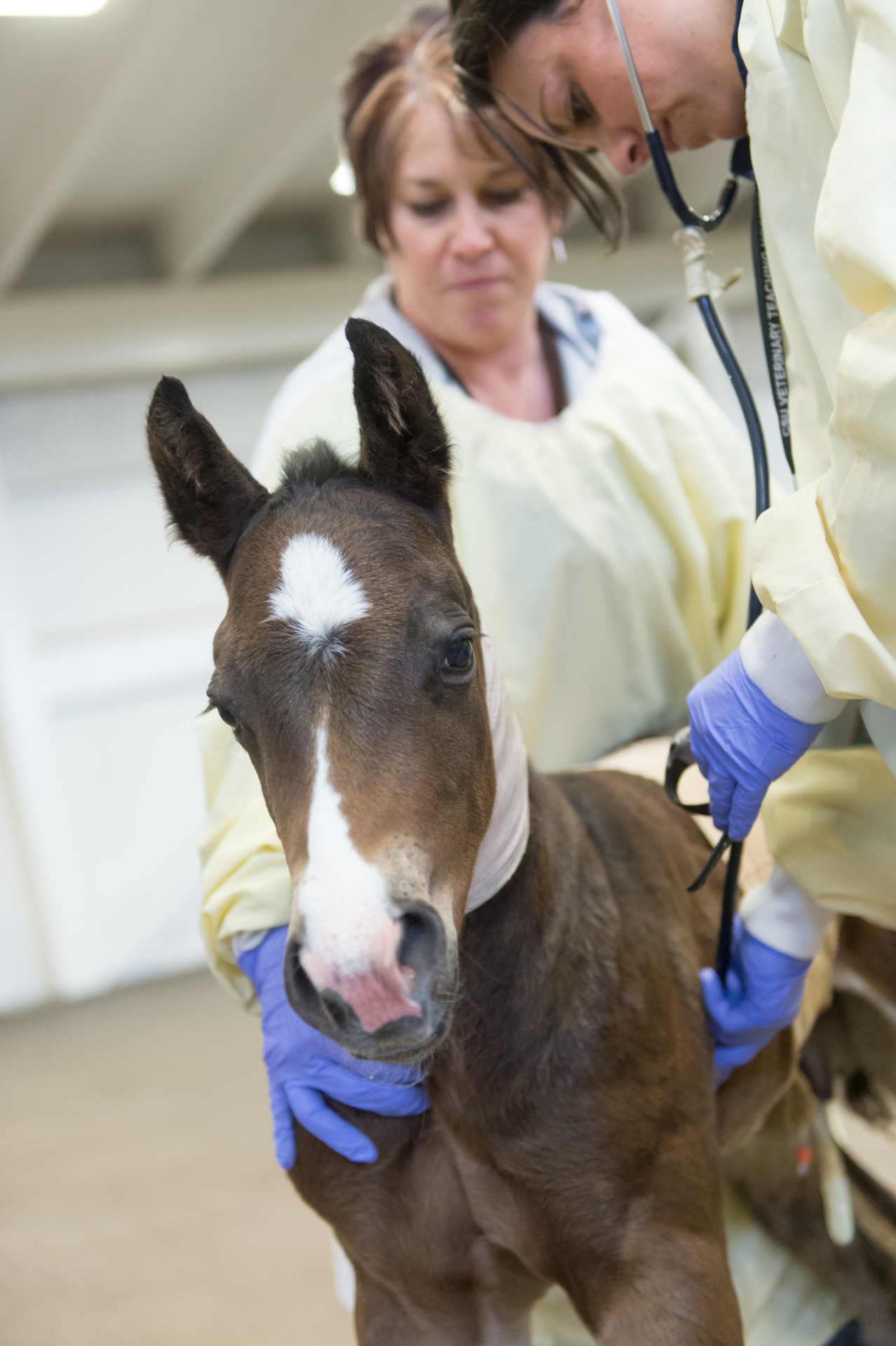
A veterinary student monitors vital signs of a foal hospitalized in the CSU equine critical care unit.
A CSU veterinary student monitors vital signs of a foal hospitalized in the CSU equine critical care unit.
“We deeply appreciate this generous gift from the Johnson Foundation, and greatly value its leadership in supporting health and education across Colorado,” CSU President Tony Frank said. “The Foundation has been a dedicated supporter of university programs for more than 20 years, and this gift will provide a monumental step forward for equine veterinary medicine at Colorado State.” Read the full story.

Do you know or employ someone who should be a member of the NVMA? Please direct them here.